
When the map runs out
On freefalls, plateaus, and learning to leap
A few months ago, during an annual Cheeky Ladies’ Lunch, one friend shared something that stuck with me:
“I feel like we don’t have a vision for our lives any more. We got married, bought a house, had kids, renovated our house... Now what? I don’t know what we’re preparing for or building toward, it just feels like endless routines broken up by vacation.”
This week, Julka brought that question back into focus. She had come to share her Story of Transformation — and arrived with something extra: a talk she had given on eagle fledging, which she now realized is the ultimate threshold.
From the moment an eagle is born, it is preparing to fledge. Baby eagles move through stages building up to this important moment: hatching, nestling, branching, fledging. Each stage prepares them for the next, building strength and skills and confidence.
Until one day, they leap into the unknown.
Julka learned about this by watching eaglecams in California and Wisconsin. While she had watched the baby eagles prepare day after day, it was still emotionally intense to see them step off their branch 150+ feet in the air.
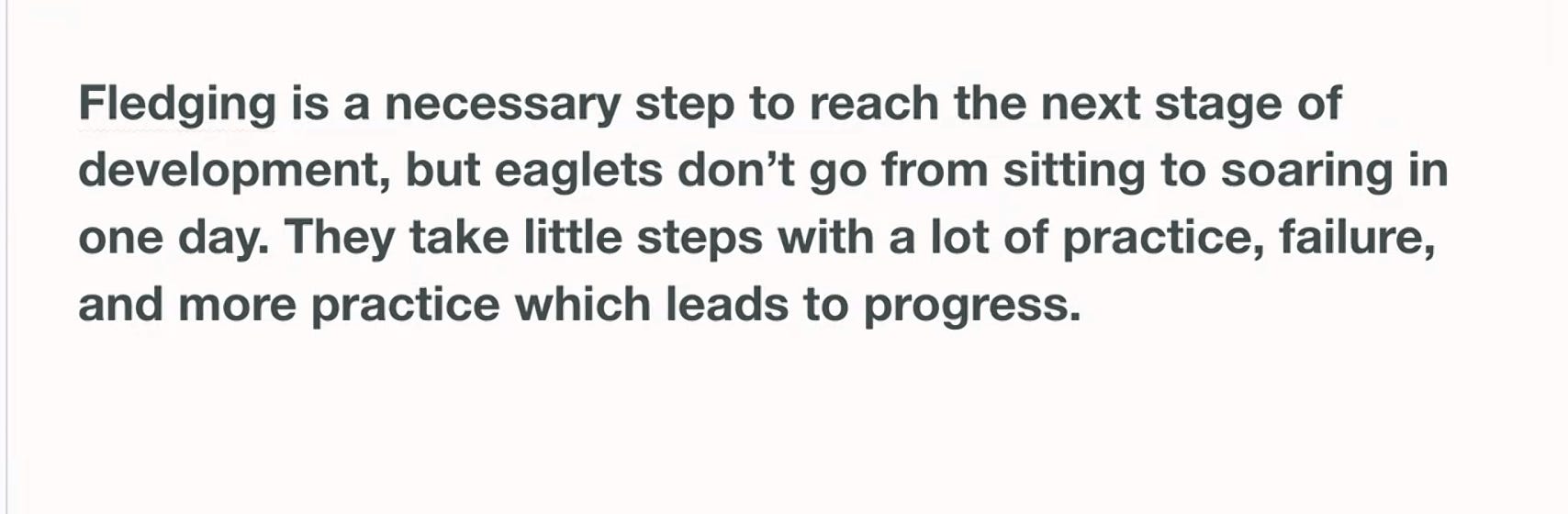
In Stories of Transformation, I do not hear people talk about necessary steps in their development. Rather, they describe a choice between continuing with endless routines, or freefalling into the unknown. The eagles have something we don’t.
There has to be another way.
The Freefall
“I started to get glimpses of myself and a desire not to choose [my known life] any more. But when I would think about it, it felt like falling off a cliff.”
Leading up to a threshold, many people describe an awareness that they need to break free from their current life: their beliefs, behaviors, and identity. They know something needs to end, but it’s scary to ‘unhook’ from life as they’ve known it. To create an ending without knowing what is beginning.
One of my storytellers, Paul, described the period of time before his heart attack like he knew a train was going to hit him. He was even asking the train to hit him. Not because he wanted the suffering, but because he needed a forcing mechanism to break free from his current reality.
Either life forces us into the next stage of growth, or we stay the course.
Both options have their cost: the pain of being dragged across a threshold, or the pain of continuing to live inside an identity that doesn’t fit.
Much like the eagles, our early years come with rites of passage: getting your driver’s license, graduating, leaving home, earning your first paycheck. Each of these thresholds invites us into our next stage of growth.
Rites of passage give us enough of a sense of what is beginning, of the necessity of moving into the next phase, without giving us all the answers for what that phase will be like.
Think back to getting your driver’s license. While it may have been scary the first time you got behind the wheel of a car on your own, it was not a freefall. Not only had you been preparing for it, you had likely participated in the systems (driver’s ed, your first ID) and rituals (curfew, family rules) around it. And you had a sense of what was available on the other side (freedom, autonomy), making it easier to accept what was ending (being driven around).
Then, we reach midlife.
The rites of passage all but disappear, but the desire to grow continues.
These are the stories I have been listening to: adults charting their own path through developmental stages, with no sense of how life has prepared them for the next stage, no rituals or systems to guide them or give meaning to the transition, and no idea what’s available on the other side.
No wonder it feels like a freefall.
“I am at this point of importance, but I feel unprepared to dive in. Like I’m on a diving board but I can’t see the pool water...yet.”
The Plateau
My dear friend Kari left the New York executive career path to find a more soul-centered alternative. The years that followed had many phases — one of which included a period of time when she moved home. If we subscribe to the ascension narrative, this feels like a failure.
But threshold work offers a different view: Kari was making a strategic choice to extend her time in the unknown, to stay in The Sacred Dark long enough to allow something new to emerge.
We praise detours, leaps of faith, and crooked career paths in theory. The actual experience of going off the ascension trajectory is something else — ripe with shame and self-judgment. It feels like failure. And yet it is exactly where the most significant growth happens.
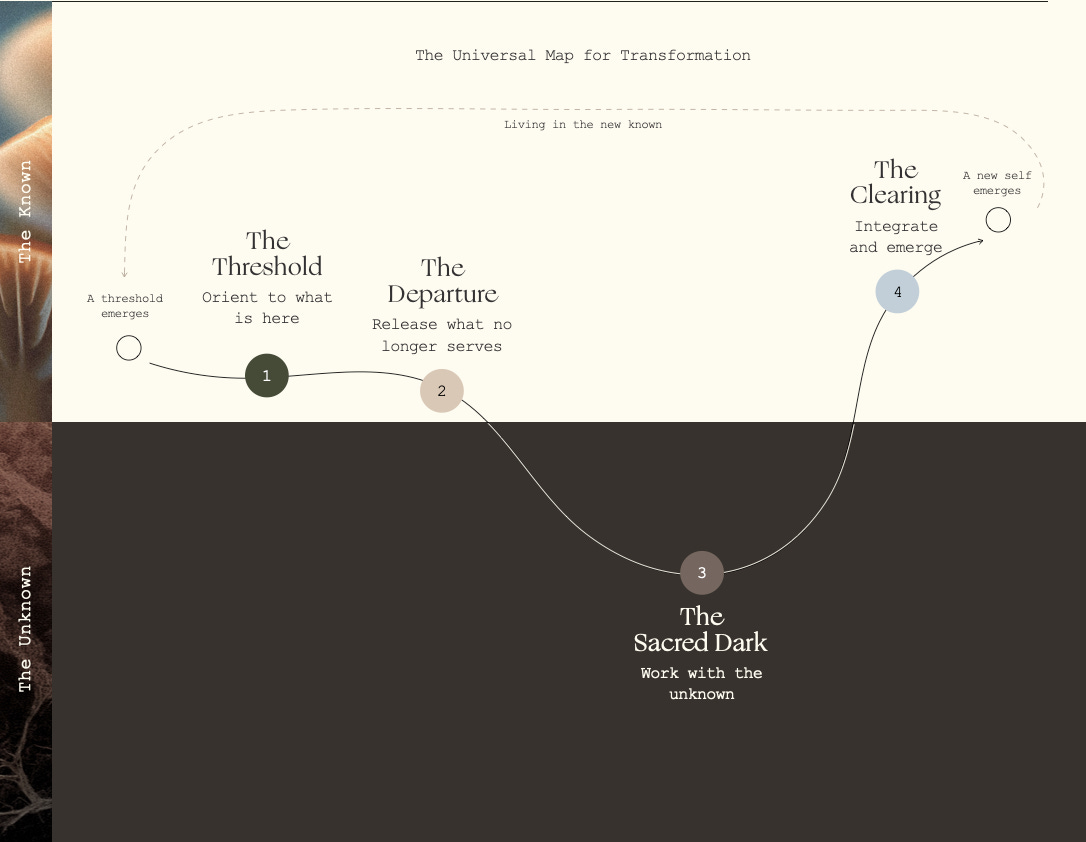
What I realized this week is that when you zoom in on the right half of The Universal Map for Transformation, it’s an S-curve. The pattern is simple: experimentation, rapid growth, plateau. It describes the life cycle of products and businesses — and, it turns out, of people.
Listening to Stories of Transformation, many people have described a period of time preceding their threshold that felt like they were “going through the motions.” I have experienced this myself, not always realizing it while it was happening. This is the plateau stage—life is familiar and legibly ascending, but the inner life has outgrown the outer life. Like an eagle stuck on the branch, over-optimized and under-challenged.
Without rites of passage, rituals and systems to guide the transition, it’s no wonder it feels like our options are to continue going through the motions, or to freefall.
What ends up happening is the forced threshold crossing. For eagles, this is called fludging — an accidental fledge. The eagle is large enough to survive flight but hasn’t chosen the leap. Then something dislodges it: a gust of wind, a sibling crowding the branch, a moment of imbalance. And suddenly it is airborne, not by choice but by circumstance. It survives — often it even thrives — but the leap was never its own.
This is what one storyteller described as “being dragged kicking and screaming across the threshold.” It is painful while it’s happening, and seen as a necessary gift in hindsight. Like being pushed from the nest, it drops people to the bottom of the S-curve — into the unknown, into The Sacred Dark.
The Leap
So what can we learn from the eagles? How might we experience the exhilaration without the kicking and screaming? There are no easy answers, but we can create scaffolding. Here is what has served me.
Find your fellow edgewalkers.
Notice how you show up around different people. Are you defaulting to your legible, optimized self? Or, are you allowing your emerging self to come forward with its vulnerabilities and curiosities? This is a signal for who might be your fellow edgewalkers—people who are willing to live at the edge of their known self, and accompany you as you leap and traverse the unknown. They are likely people who have leapt themselves, or who are coming up on their own edge. Find ways to share a branch with these people, to witness and encourage each other. To normalize the emotional roller coaster, to ritualize big moments, to share systems of support.
Trace your thread.
Taking a big leap implies leaving everything that came before behind. After crossing a threshold, it can feel like your former life has been burned to the ground. But, upon closer look, life has prepared you for this moment. One storyteller described her preparation as going to the “uncertainty gym”—the prior thresholds she had crossed, and the skills and tools collected as a result. Another storyteller described how she came to view her career changes not as “pivots” —which implies a sharp break from the past—but as a creative thread, adding “beads” on a continuous, evolving line. And yet another storyteller described the shift from intellectualizing the work of human-centered design to embodying it. Be willing to connect unlikely dots, to see cumulative growth, to ask yourself: How has life prepared me for this moment?
Experiment at your edges.
If you’ve reached a plateau, and are coming up on an edge, you are likely noticing the areas of your life that feel charged, on that line between longing and fear—like standing on the edge of a branch. Allow yourself to stay with that feeling: What patterns do you notice about when it shows up? What experience might be available on the other side? Create small experiments to identify what makes you feel alive. For one storyteller, this looked like sending two emails a day to potential collaborators sharing her emerging work. For another, it looked like getting in front of the camera to see herself differently. And for another, it looked like enrolling in an herbal medicine course, unclear where it was going. Your edge is about a part of yourself that is longing to be seen. Play with it.
When I watch the eaglecams, I can feel the elemental nature of life: as magical and mystical as it is fleeting and precarious. The nest feels small, and the view feels expansive. I am left wondering: if we strengthened our nests—our communities, our rituals, our rites of passage—would we be emboldened to experiment toward the expansive future we long for but can’t yet see?
Thank you to Julka for inspiring this essay, and to all of the people who have shared their stories with me. You can sign up to share your story here.