
Befriending the Dark
6 practices for being with the unknown
Once you have befriended darkness, you no longer seek to escape your life but seek to experience it on a deeper level. You create space for it all: light and dark, joy and heartbreak, and everything in between. - Martín Prechtel

I want you to have the experience of befriending darkness.
But darkness is scary, you might think. I don’t want to befriend darkness.
I understand.
Here’s what I know: darkness is inevitable. No one gets through life without facing the unknown.
So why not learn to be at home in it?
Here are six practices to feel more at home in the dark. For each one, I’ll share the general principle, and some specific examples of how I’ve seen it in practice. Take what resonates, remix or leave the rest.
Tend the vessel
Yes, it’s boring and basic, and I may sound like your mom nagging you. But, really: Are you getting enough sleep? Moving your body in ways that feel good? Eating real food? We’re all living inside of a body, right here and right now. That body needs care. It is the foundation for how you meet everything life throws at you.
One tend-the-vessel practice that I have been known to evangelize is the Cultivate What Matters annual planner. In addition to the bigger picture perspective the planner’s process provides, each month includes a simple tool called the Tending List.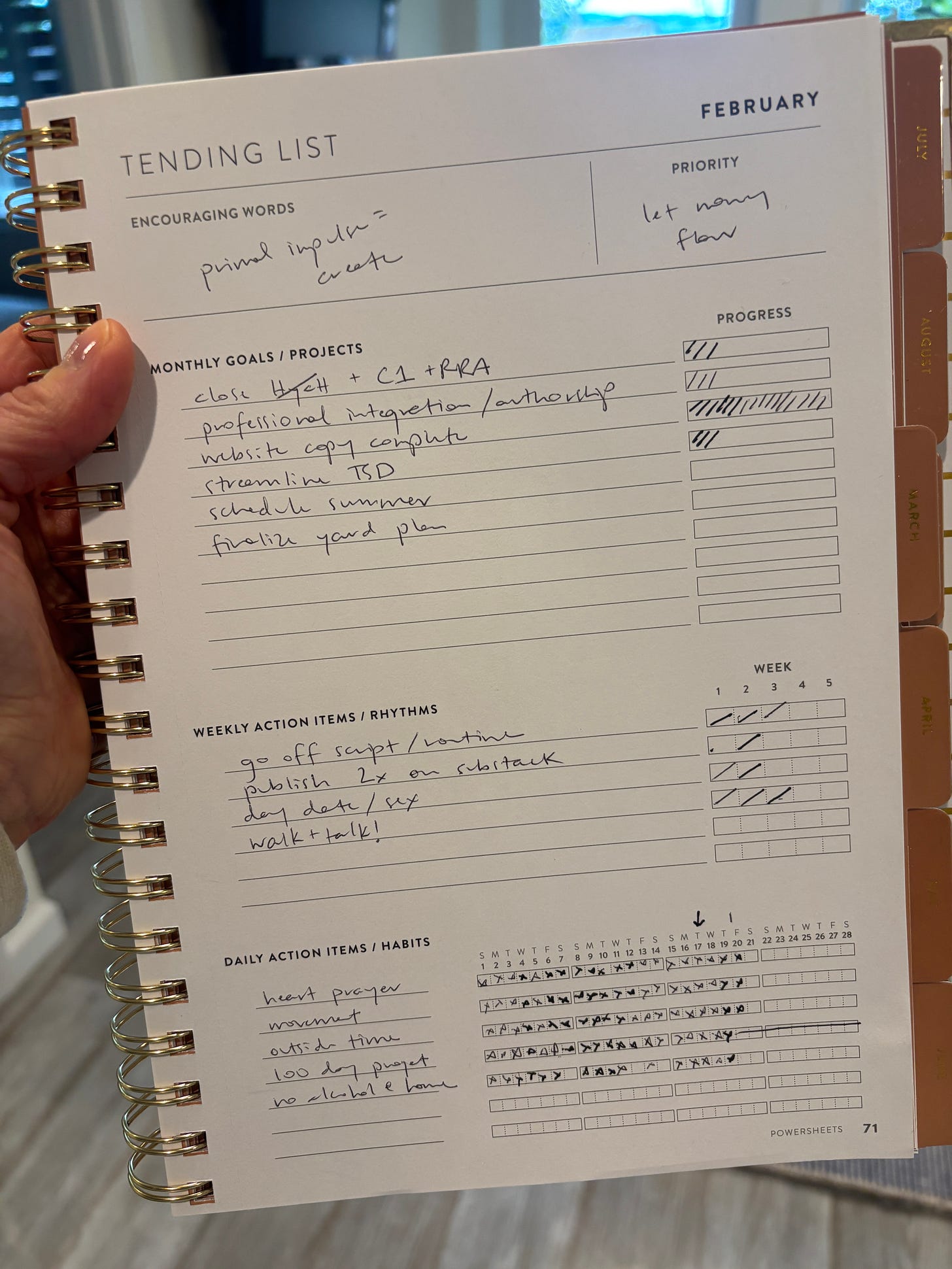
More than you wanted to know about what I’m currently tending. The Tending List is broken into monthly, weekly, and daily. The daily rhythm is where this work shows up most clearly: items that are both radically basic and extremely important. For example, if you work from home and it’s winter, you might need daily accountability to go outside, or get dressed, or eat somewhere other than your desk.
When you are uncomfortable in your own body, it is impossible to befriend the dark. Escape feels like the only strategy.
Start here.Honor your tethering
There are times when life throws everything up in the air at once. But, more often than not, some dimensions of our lives remain constant, tethering us as we navigate the unknown.
As one of my clients was approaching a major professional threshold, he noted, “I am not transforming my marriage, where I live, our foundational security in our lives. This foundation is giving me the courage to take a leap.”
I use a tool called Cycles of Life with my clients to bring awareness to where life feels tethered, or steady state, and where it feels up in the air, nearing completion, or ready for reinvention.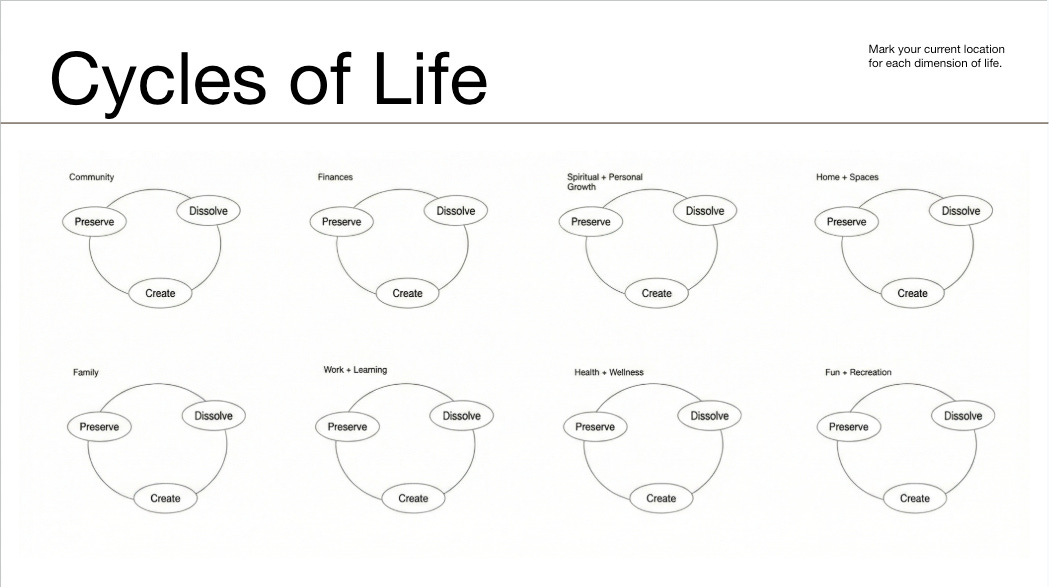
A simple yet radical reframe on how life unfolds. For each dimension of life, which phase are you in? What changes do you anticipate on the horizon? Anticipated changes might be the result of age, health, aging parents or children, or shifting needs and desires.
After you’ve done your analysis, consider which dimensions of life are inviting you to cross the threshold into the unknown. Which dimensions are tethering you, providing a foundation from which you can befriend the darkness?Reduce the noise
Life is so loud. I’m neurodivergent and extra sensitive to sensory inputs, but I think the overwhelming stimulus of daily life affects us all at this point.
This state of constant stimulus makes it nearly impossible to discern our desires, feelings, and inner voice from the noise of the outside world. Known as “digital-neural blurring,” the brain struggles to distinguish between the rapid-fire external reality of social media and the self-generated, internal stream of consciousness.
A friend recently extended the media diet metaphor to metabolism: ‘If you are busy metabolizing the pain of the world, how will you ever get to the pain of your own life?’
The noise isn’t just distracting—it’s replacing our inner life entirely.
Reducing the noise is uncomfortable at first, but essential if you want any chance of befriending the darkness.
Practices to try: Tech Shabbat, establishing phone free zones in your home, turning your phone into a dumb phone. Notice what emerges when you create space—there’s a well of creativity underneath all that noise.Name that feeling
Because life is loud, and our internal and external signals are mixed up, it can be difficult to notice, much less to name, how we’re actually feeling. Not your standard ‘fine’ or ‘good,’ but the ability to interpret more nuanced sensory and emotional messages.
This is an actual skill that we are not taught. Somatic practices have been rising in popularity, but I still find disassociation to be a common coping strategy, and people’s emotional vocabulary to be extremely limited. I often suggest people print out the Feelings Wheel and put it on their fridge as a daily reminder to check in.
This awareness is especially important when befriending the dark because feelings are more dynamic and even volatile when you are in the unknown, outside of the focused attention of meetings and deadlines, and the predictable routines of daily life.
When you notice a big shift in your internal weather system, ask yourself: Have my external conditions changed (safety, comfort, support), or has my mind latched onto something that needs releasing?
More often than not, it’s the mind that’s gone sideways. Acknowledging this can be grounding, and gives you agency in how to channel the feeling. For example, getting out of the mind and into the body by cooking, drawing, gardening, folding laundry, stretching. It doesn’t really matter what it is, it’s about breaking the rumination loop.
The loop is an escape route, the body brings you back to yourself. The body befriends darkness.Exchange stories
Darkness can be an isolating place. I am no longer surprised when a client tells me I am the first person who has ever listened to their threshold story. It’s not that they don’t have friends and loved ones. It’s that we tend to think we are burdening others with our hardship, our messiness, or our confusion, when really the opposite is true.
People want to be needed, they want to listen. And suffering connects us to other sufferers, which is everyone.
As a wise client pointed out, “Sharing what I’m going through keeps me from going down the shame spiral.”
The barrier is often finding the starting place, the conversation opener, but it can be as simple as: I am going through a lot of change right now. Can I tell you my story? It will help me make sense of it myself.
One of the most direct routes to befriending darkness is to go there with someone. To witness and be witnessed.Court darkness
There is a Buddhist expression, “Not knowing is most intimate” which I interpret as a sensory aliveness that is unique to moving through the unknown. We move through the familiar with varying degrees of autopilot, often multi-tasking, and disconnected from our environments. But the unknown is an invitation to be fully present.
Life thrusts us all into the unknown at some point, but we can also make a practice of going off script, making the unpopular choice, slowing down, choosing the thing that spins up resistance, and staying, especially when it’s uncomfortable.
These are all moments of courting darkness, inviting it into our emotional field, and dancing with the unknown. The practice is small: What’s one thing you could do this week that feels uncertain but alive?
Maybe you’re in the unknown as you read this. Maybe you’re anticipating a major threshold, or on the other side of one that has shaped you in ways you can’t yet put into words.
Regardless of your location, being with the unknown—calmly, gracefully, expansively—is a practice. And befriending darkness is the path to experiencing yourself more fully.